
 Toggle Nav
Parts On Demand
High Performance Plastics
HI TEMP 300-AMB
Material Overview
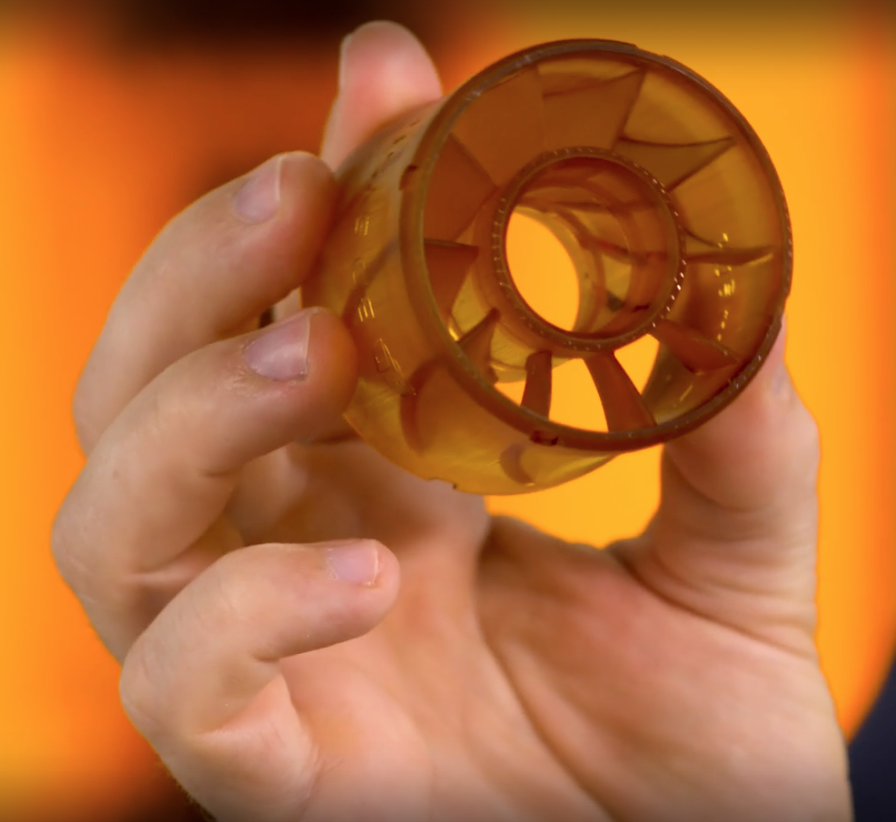
HI Temp 300-AMB 3D printing material is an ultra-high temperature plastic for use in applications requiring high heat resistance. With heat deflection temperature of over 300 °C at both low and high stress (HDT at 0.455 and 1.82 MPa), this material is well suited for the testing of high temperature components in applications including HVAC, consumer appliances, motor enclosures, stators, molds and the like. It does not require a secondary thermal post-cure.
Common Applications
High temperature components testing and general use parts including: HVAC, consumer appliances, motor enclosures, stators, etc.
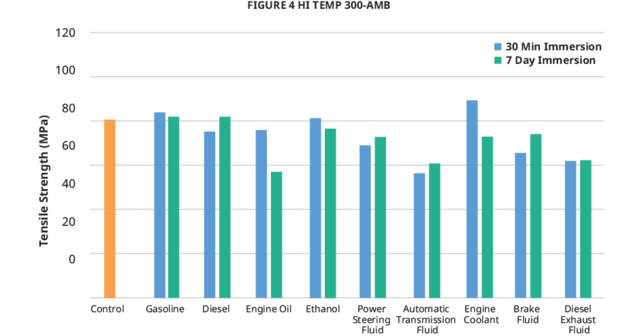
Automotive Fluid Compatibility
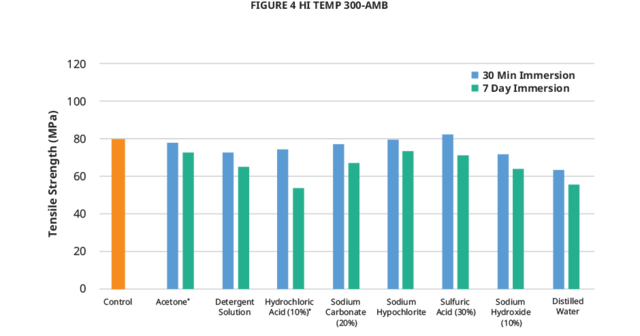
Chemical Compatibility
Key Material Properties
Heat Deflection Temperature
Rigid and Translucent
High Tensile Modulus
Tensile Strength (MPA) 4000
Elongation at Break % 3
Impact Strength (J/M) 10
HDT at 0.4555 MPA 300°C
Maximum Part Size 124.8 x 70.2 x 196 mm (4.9 x 2.8 x 7.7 in)
Layer Thickness Options 10, 20, 30, 40, 50, 100 Micron Layers
What is the 3D printing process for this material?
HI TEMP 300-AMB is 3D printed utilizing 3D Systems' Figure 4 DLP (digital light processing) 3D printing technology. The Figure 4 is a high-speed 3D printer that offers the quality and performance of injection-molded parts with smooth surface finish and exceptional sidewall quality, without the time or cost of tooling.
Will there be support scarring on this part?
The figure 4 material utilizes small supports similar to stereolithography (SLA). When removing the support structure duing post processing, small nubs will remain on the part. it is important to identify the class A surface of the part before printing to ensure that the small support nubs do not touch the crititcal surface of the part.
How long will it take before I receive my part in this material?
Production times vary depending on machine availability, but generally HI TEMP 300-AMB parts are printed and shipped within 3-5 business days.
What is the part accuracy and tolerances that this material can hold?
Accuracy is dependent on the geometry in question; not just the size of the part, but also the shape and cross-sections. As such, accuracy capability is best evaluated in the context of a specific part example. For the small plastic part in the presentation, we were able to get around 35 microns on average, with a range of +/- 150 microns. In a dental application for a 60,000 micron arch, we were able to keep 100% of surfaces within +/- 100 microns
What are some of the specific design considerations when designing parts for this material?
The design considerations recommended for HI TEMP 300-AMB are similar to those recommended for any photopolymer 3D printing technology. You will want to give thought to the kinds of design considerations and fundamental ranges of capability that apply for any manufacturing device, such as minimal wall thicknesses and things of that nature, which tend to vary from geometry to geometry and part to part. Often the best way to determine the functional range for a specific application is to print it and test it. Iterate out all the opportunities for manufacturing efficiencies before you scale up to high volume production.
Upload A File To Get Started